Breaking the Cycle: How Exposure and Response Prevention Therapy Helps You Reclaim Your Life from Obsessive-Compulsive Disorder
By Jenny Do, M.Ed., RP(Qualifying)
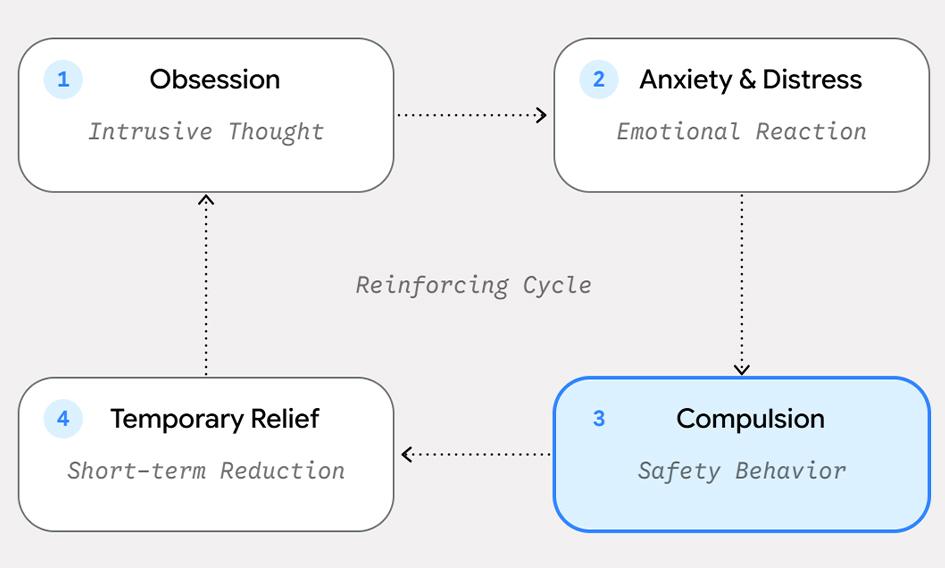
Obsessive-Compulsive Disorder (OCD) is frequently misunderstood in popular culture as a quirky need for neatness or cleanliness. In reality, it is a debilitating condition characterized by a vicious and exhausting cycle. The cycle begins with obsessions, which include unwanted, intrusive thoughts, images, or urges that trigger intense distress, fear, anxiety, guilt, or disgust. To cope with these overwhelming feelings, individuals engage in compulsions, also called safety behaviours, which often take the form of physical actions or mental behaviours performed to neutralize the fear or prevent a dreaded outcome.
While these compulsions provide short-term relief, they ultimately reinforce the OCD cycle, teaching the brain that the only way to cope with anxiety is by performing these behaviours. This prevents individuals from learning that the feared outcome may or may not happen regardless of whether they perform the compulsion, and that feelings of anxiety and distress, although uncomfortable, are not life-threatening and can be tolerated. For some individuals, safety behaviours can take up so many hours each day that work, studies, or relationships are severely impacted. Safety behaviours such as avoidance can also cause one’s world and life to become increasingly restricted over time.
The good news is that there is a highly effective, evidence-based treatment designed to break the OCD cycle: Exposure and Response Prevention (ERP) therapy. Widely considered a first-line treatment for OCD, ERP helps individuals face their fears and take their lives back.
Here is a closer look at what ERP is, how it works, and why it can be so transformative.
What Is ERP Therapy?
ERP can sound intimidating at first, but a good therapist will never force you to confront your worst fear without a plan. It is a collaborative treatment that involves two main components:
- Exposure: Gradually and intentionally confronting the thoughts, objects, situations, or uncertainty that trigger your obsessive fears.
- Response Prevention: Making the conscious, active choice not to engage in the compulsive behaviours or mental rituals you typically use to obtain relief from anxiety, which is often short-lived.
By facing the trigger and resisting the compulsion, you deny OCD the reassurance and relief it seeks.
How ERP Works in Practice: The “Fear Ladder”
You do not have to tackle your biggest fears on day one. You and your therapist will work together to create a “fear ladder” (or exposure hierarchy), listing your triggers and ranking them based on the level of anxiety they cause. You begin with manageable challenges and gradually work your way up as your confidence grows.
Retraining the Brain: Why ERP Is So Effective
The true goal of ERP is not simply to make the anxiety magically disappear; the goal is learning.
When you sit with anxiety without performing a compulsion, your brain learns a few vital lessons:
- Your catastrophic predictions may not materialize.
- Anxiety can naturally peak and then decrease over time, even without completing a ritual.
- You realize that you are capable of tolerating discomfort and uncertainty.
The Lifelong Benefits of ERP
The most profound benefits of ERP can extend far beyond symptom reduction. Practicing ERP teaches you to cope more effectively with any unwanted intrusive thought, which can involve different topics and concerns at different points in life. ERP empowers individuals to accept the inherent uncertainty of life and make choices based on their personal values, rather than what their OCD dictates.
If you or a loved one is struggling with OCD, know that you do not have to live at the mercy of intrusive thoughts. By working with an ERP therapist, it is possible to break the cycle and reclaim your life.